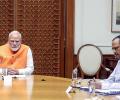
India's National Security Advisor Ajit Doval briefed US Secretary of State Marco Rubio on the country's missile strikes against nine terrorist targets in Pakistan. The strikes, dubbed "Operation Sindoor," targeted terrorist infrastructure in Pakistan and Pakistan-occupied Jammu and Kashmir. India stated that the strikes were measured, responsible, and non-escalatory in nature, targeting only known terror camps. The strikes followed a deadly attack on civilians in Jammu and Kashmir on April 22, for which India has accused Pakistan-based terrorists. The Indian government has cited credible leads, technical inputs, and survivor testimony as evidence of Pakistan's involvement in the attack.
Congress general secretary in-charge communications Jairam Ramesh said that at a time when the BJP should be targeting Pakistan and terrorists, it is only interested in attacking the Congress.

US Secretary of State Marco Rubio on Thursday spoke separately with External Affairs Minister S Jaishankar and Pakistani Prime Minister Muhammad Shehbaz Sharif, emphasising the need for de-escalation and reiterated his calls for Pakistan to take concrete steps to end any support for terrorist groups.

Doval said India hit nine terror targets crisscrossing Pakistan with precision and missed none of them
An Indian delegation met top officials of the United Nations Office of Counter-Terrorism (UNOCT) and Counter-Terrorism Committee Executive Directorate here even as New Delhi stepped up efforts to designate The Resistance Front, a Lashkar-e-Tayyaba proxy, as a UN-listed terror outfit for its alleged involvement in the Pahalgam attack.

India's recent missile strikes on nine terrorist locations in Pakistan and Pakistan-occupied Kashmir (PoK), including Bahawalpur, mark a significant escalation in the long-standing military tensions between the two nations. This article provides a historical overview of the Indo-Pak military confrontations, tracing their roots back to the 1947 war following India's independence and the partition of the sub-continent, and highlighting key conflicts such as the 1965 war, the 1971 Bangladesh Liberation War, the 1999 Kargil War, the 2016 Uri attack, and the 2019 Pulwama attack.
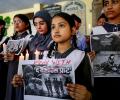
Aishanya Dwivedi, wife of a victim of the Pahalgam terror attack, demands 'Martyr' status for all 26 victims and criticizes political leaders for undermining the gravity of the attack.
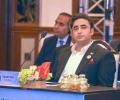
Bhutto, who served as the Foreign Minister earlier, addressed a briefing at the UN Headquarters in New York and sought reconciliation with India, making a plea for talks and Intel sharing between the two neighbours.

Security agencies in Jammu and Kashmir are facing a new threat from 'bedroom jihadis' who use social media to spread misinformation and incite communal discord. These individuals, operating from their homes, are part of a sophisticated cross-border effort to destabilize the region by disseminating inflammatory content and propaganda.

A woman arrested for allegedly promoting Al-Qaeda's agenda had appealed to Pakistan's Army chief to invade India to unify Muslim lands under Project Khilafat, officials said.

Tharoor led a multi-party delegation, visiting various countries, to apprise the world about India's stand against cross-border terrorism following Operation Sindoor, which was launched in retaliation against the ghastly Pahalgam terror attack that claimed 26 lives.
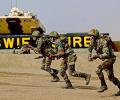
The Indian Army's broader reorganisation is inevitable as India's military doctrine adapts to the demands of the modern battlefield.
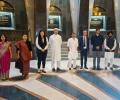
Terrorism is a global menace to be addressed by humanity in unison was the all-party delegation's message to Algeria as it concluded its visit to the North African country on Sunday.
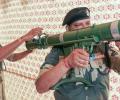
The Border Security Force (BSF) is raising a maiden 'drone squadron' for deployment along the India-Pakistan border. The squadron will comprise reconnaissance, surveillance and attack drones and specially-trained personnel.

Prime Minister Narendra Modi will chair a meeting of the Union Council of Ministers on Wednesday, the first after India's punitive military action against Pakistan under Operation Sindoor launched in response to the Pahalgam terror attack.

All India Majlis-e-Ittehadul Muslimeen MP Asaduddin Owaisi, part of the all-party delegation led by Bharatiya Janata Party MP Baijayant Panda, said that terrorist groups wrongly use religion to justify killing innocent people.
'Unlike the surgical strikes and the Balakot air strikes across the LoC, we have gone further inside Pakistan and raised the bar of escalation.'

Asserting that India will not tolerate any 'nuclear blackmail', Prime Minister Narendra Modi on Monday said operations against Pakistan have only been kept in abeyance and the future will depend on their behaviour.

India succeeded in busting the Pakistani narrative on Operation Sindoor, particularly among the Organisation of Islamic Conference (OIC) member nations, where Islamabad sought succour after carrying out terror activities across the border, Shiv Sena leader Shrikant Shinde said.

The attack has "footprints and tracks" similar to previous attacks claimed by The Resistance Front, the ministry said in a presentation, adding the terror organisation is just another name of designated terror outfit Lashkar-e-Tayiba.
'The Pakistanis called the US state department and said we agree with India on peace.' 'It was then that US President Donald Trump jumped in and took credit for the ceasefire.'

Jaishankar said such a description would be like putting the perpetrator and the victim of the Pahalgam attack at the same level.

External Affairs Minister S Jaishankar addresses Parliament on Operation Sindoor, denying any US trade linkage and highlighting Pakistan's request for a ceasefire through the DGMO channel.

The Indian Army has released a booklet on Operation Sindoor, which was launched to avenge the April 22 ghastly Pahalgam attack in which Pakistan-backed terrorists brutally killed 26 civilians, mostly tourists, and left many injured.
'The fight against terrorism will continue. We have set a new normal and the new normal is that we will follow an offensive strategy. Wherever terrorists are, we have to kill those terrorists and we have to destroy their infrastructure. So it is still not over but as we speak the ceasefire is still intact'

India has accused Pakistan of being a "rogue state" fueling global terrorism, following a confession by Pakistan's Defence Minister Khawaja Asif admitting to his country's history of supporting and funding terrorist organisations. India's Deputy Permanent Representative to the UN, Ambassador Yojna Patel, delivered a strong Right of Reply at a UN event, highlighting Asif's admission and condemning Pakistan's actions. Patel asserted that the world can no longer turn a blind eye to Pakistan's role in supporting terrorism.
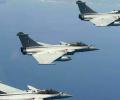
French officials believe the campaign against Rafale was part of a coordinated disinformation drive by China and Pakistan, although their State involvement has not been established.

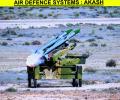
Pakistani drones were intercepted by Indian air defence in Jaisalmer. Explosions were heard and flashes seen in the sky.

The anti-terror operation was part of Indian security forces' counter-offensive Operation Asan, launched after terrorists attacked an Army convoy in the Battal area on October 28.
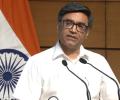
India carried out missile strikes on terror targets in Pakistan and Pakistan-Occupied Kashmir, including the Jaish-e-Mohammad stronghold of Bahawalpur and Lashkar-e-Taiba's base in Muridke, after the Pahalgam attack that killed 26 civilians. The Foreign Secretary said the actions were measured, non-escalatory, proportionate and responsible.
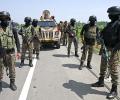
India needs to be technologically and militarily prepared to defend itself from both Pakistan and China, alerts Ramesh Menon.

Tahawwur Hussain Rana, a Pakistan-born Canadian national and close associate of David Coleman Headley, could be extradited to India in connection with the 26/11 Mumbai terror attacks. Rana's travel history in parts of north and south India before the attacks in 2008 is expected to provide crucial leads for the investigation. His extradition would mark the third person to be tried in India for the attacks, after Ajmal Kasab and Zabiuddin Ansari alias Abu Jundal.

Under Operation Sindoor, Indian armed forces not only struck Pakistani military bases near the border but their might was even felt in Rawalpindi where the headquarters of the Pakistani Army is located, Defence Minister Rajnath Singh said on Sunday.

When asked whether both armies talked to each other, initiated by the Pakistani army, Jaishankar said, "Yes, we have a mechanism to talk to each other as a hotline. So, on the 10th of May, it was the Pakistani army which sent a message that they were ready to stop firing, and we responded accordingly."
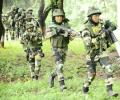
Among the medal winners are a deputy commandant rank officer, two assistant commandants and an inspector.
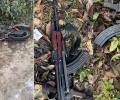
Two AK-47 rifles, two Glock pistols, and a huge cache of ammunition were seized from them, he said.

The Congress on Sunday cited the reported comments of India's defence attache to Indonesia that the Indian Air Force lost fighter jets to Pakistan during Operation Sindoor and accused the government of having 'misled' the country.

Salakaar is full of heart, and emotionally satisfying, applauds Syed Firdaus Ashraf.

The Indian Air Force conducted precision strikes on terror hideouts in Pakistan, targeting a Jaish-e-Mohammad communication network housed in a primary health centre in Tehra Kalan village. The communication setup was essential for planning and coordinating activities with infiltrated terrorists in Jammu and Kashmir. The strikes aim to dismantle the communication network and hinder the terrorists' ability to operate.

The Border Security Force (BSF) launched "Operation Sindoor" in retaliation to unprovoked firing and shelling by Pakistani Rangers along the International Border (IB) in Jammu. BSF troops destroyed three terrorist launch pads and targeted 76 Pakistani border outposts and 42 forward defence locations. The BSF action came after Pakistan launched heavy firing and shelling on 60 Indian posts and 49 forward positions, reportedly providing cover for an attempted infiltration by 40-50 terrorists.
